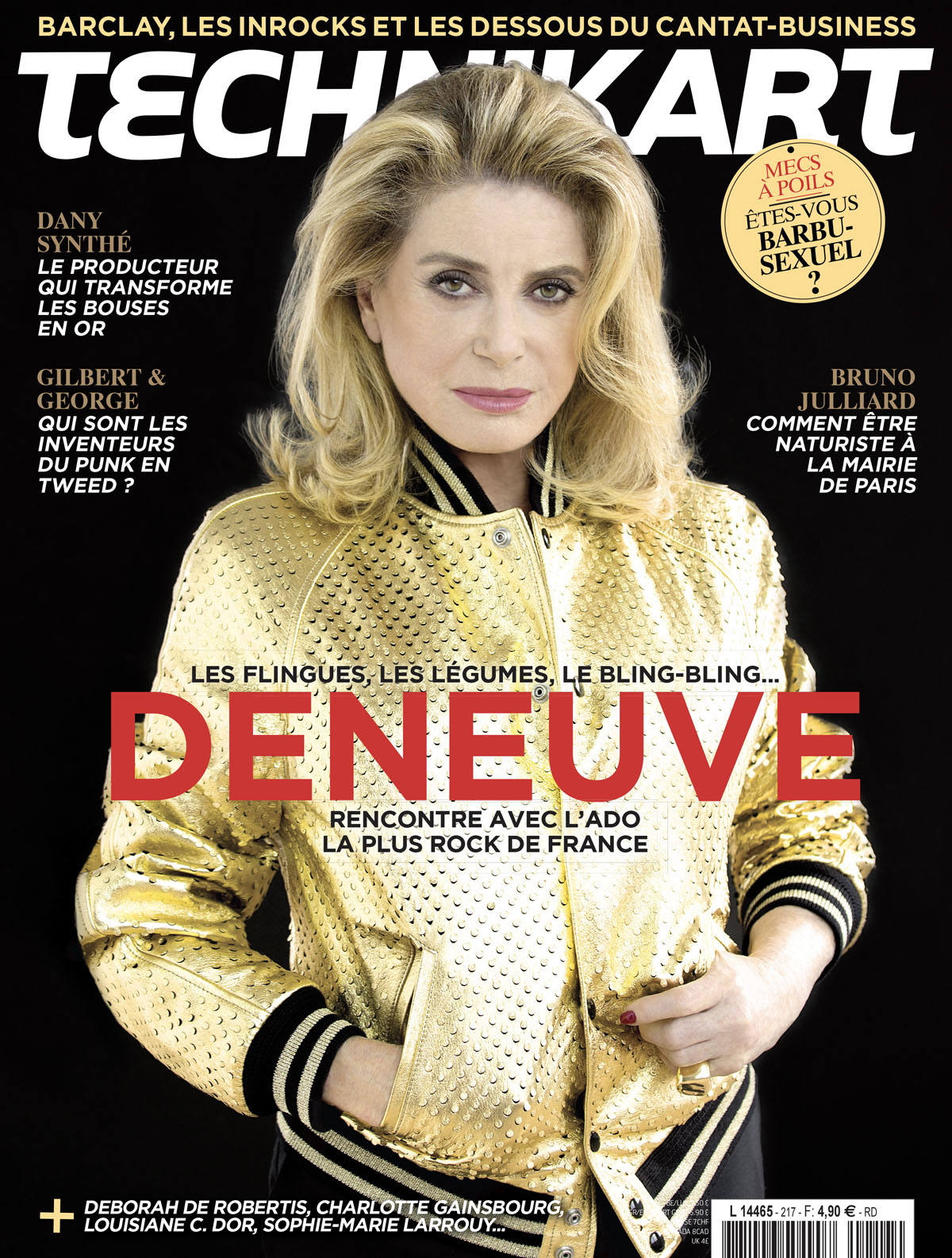

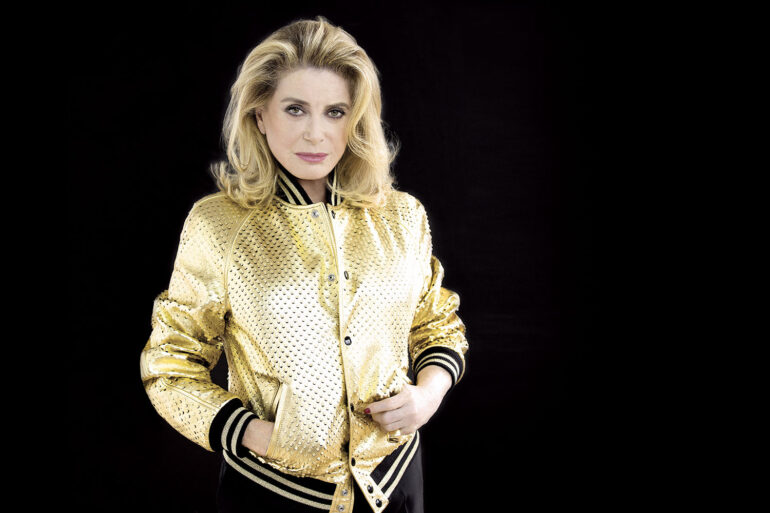
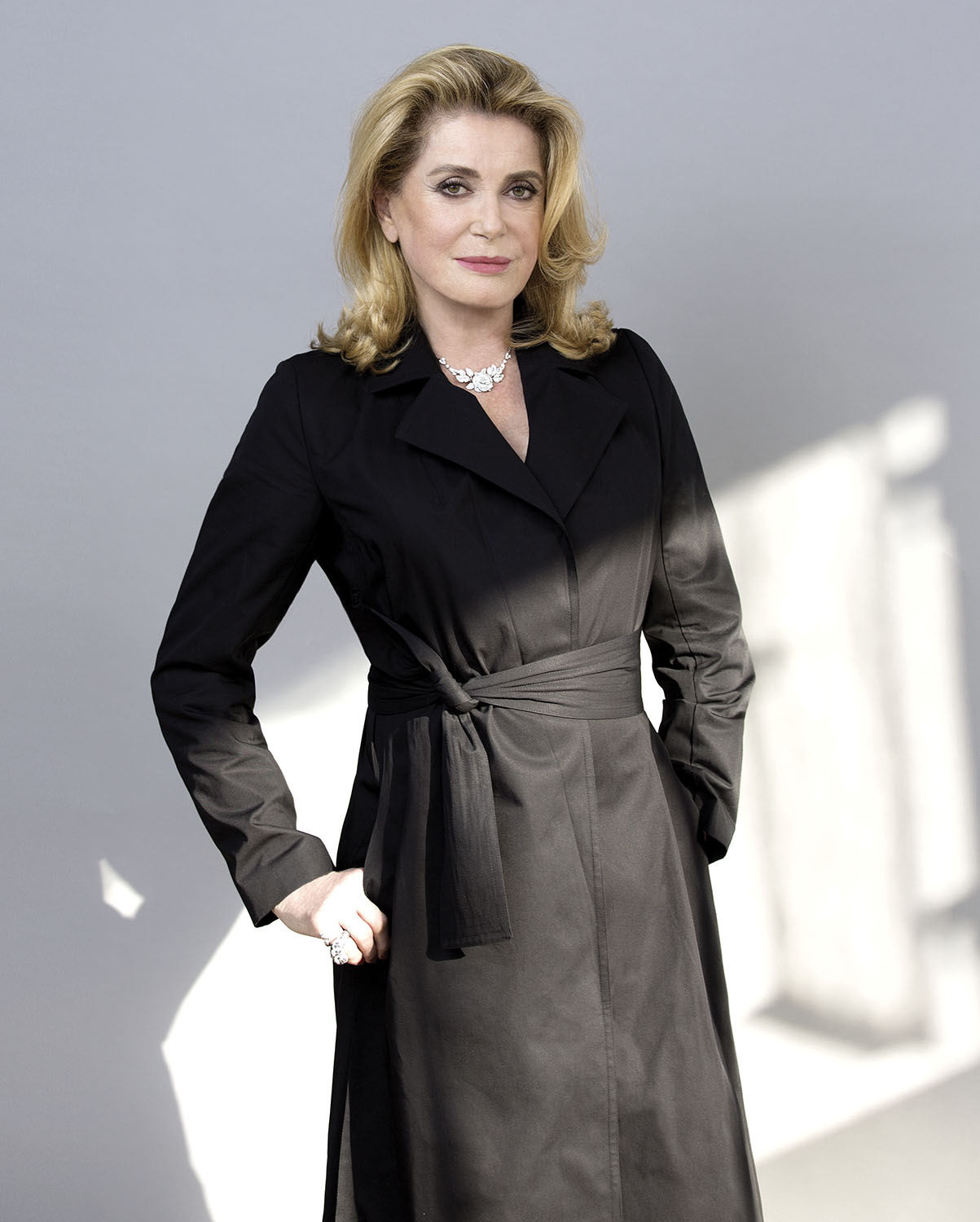
Dernière star française toujours en activité, mademoiselle Deneuve est à l’affiche de Tout nous sépare, un flingue à la main et entourée des bad-boys Nekfeu et Duvauchelle. En pleine cure de jouvence, elle a accepté de passer à confess’ pour Technikart : sa filmo, la mode, la célébrité, les agricultrices, la retraite…
« ELLE EST L’UNE DES PLUS GRANDS AUTEURS FRANÇAIS. » – ARNAUD DESPLECHINS
Paris Rive Gauche.
Un vendredi du mois d’octobre, Pile à l’heure pour le rendez-vous avec notre cover-star, je m’y rends d’un pas guilleret. J’ai vu son film du moment (Tout nous sépare de Thierry Klifa, une petite chose non-dénuée d’intérêt qui nous permet de la voir manier un flingue), relu l’émouvant livre hommage à sa soeur Françoise Dorléac préfacé par Modiano (il est réédité ces jours-ci) et potassé des dizaines de ses interviews (à les lire, on comprend mieux comment Catherine Deneuve se retrouve avec cette filmo’ qui en fait, pour reprendre la phrase d’Arnaud Desplechins, « un des plus grands auteurs français »)… À quelques mètres du bar d’hôtel choisi pour l’interview, je suis pris d’un doute. Peut-être faut-il préciser que je ne suis pas venu les mains vides. Connaissant son goût de terroir, j‘apporte une offrande. Un cageot rempli des meilleurs légumes de l’île de France – des cèpes, quelques beaux panais, un magnifique brocoli (et une bouteille de champagne, quand même) –, le tout sélectionné par nos voisins de chez Maxan (3 rue Quentin Bauchart, 75008). Mais vu le look « straight outta Rungis » de la cagette, aurais-je commis un terrible impair ?
« Oh comme c’est drôle ! » Une fois la chose présentée à notre interviewée – pimpante, affable, garde robe couture, déjà la première Vogue de l’après-midi à la main –, me voilà rassuré. (Le soir-même, elle prendra la peine d’appeler le restaurateur pour le remercier. Classe.) Nous nous posons en terrasse, commandons les cafés, elle allume sa cigarette, nous pouvons commencer.
Dans Tout nous sépare, vous jouez une bourgeoise exaspérée par les mauvaises fréquentations de sa fille – au point de les accueillir sur le seuil de chez elle avec un fusil à pompe. Ça fait plaisir de vous voir une arme à la main.
Catherine Deneuve : Ah vous trouvez ? C’est un truc qui m’a beaucoup fait hésiter. Ça m’a même posé des problèmes.
D’ordre moral ?
Non. (Rires.) De crédibilité.
Cette femme pourrait très bien avoir une arme dans sa cave, non ?
C’est assez brutal quand même. Bon, j’ai déjà fait un film policier où j’avais une arme pour lequel j’ai appris à tirer. Mais je trouve qu’une actrice un peu connue qui se retrouve avec une arme à la main, ce n’est pas évident.
Il s’agissait d’un polar méconnu, Écoute voir (Hugo Santiago, 1978), dans lequel votre personnage était un as du karaté sachant se servir d’un revolver.
J’y jouais un détective privé alors j’avais tout le temps cette arme sur moi, c’était donc une chose établie. Mais dans un film comme Tout nous sépare, on raconte les relations entre une mère et sa fille, et les mauvaises fréquentations de celle-ci, et d’un seul coup, ça fait…
Irréaliste ?
Oui. J’ai dit à Thierry Klifa que ça me posait un problème de crédibilité, je ne voulais surtout pas que ça fasse rigoler. Du coup, j’ai attaché beaucoup d’importance à ce que la lumière soit bien.
La lumière ?
Ah oui ! Qu’elle soit dense, que ce soit un truc pas trop éclairé… Mais bon, sur la photo
je n’ai eu aucun souci, c’était Julien Hirsch (directeur de la photo des films d’André Téchiné entre autres, ndlr). Il fallait que les choses ne soient pas trop exposées, qu’il y ait quelque chose d’un peu inquiétant pour rendre la scène plus crédible.
Et le fait d’avoir à bouger un cadavre, aussi ?
Alors ça, ce n’était pas difficile. Extrêmement pénible, mais pas difficile !
Vous aimeriez que l’on vous offre davantage de rôles physiques ?
Ah non ! J’en ai fait quand même pas mal, des rôles où je cours, je pleure, je vole des choses, je vole des bagnoles… Les rôles physiques, je n’ai rien contre, mais ce n’est pas vraiment ce que je recherche.
Que recherchez-vous en lisant un scénario aujourd’hui ?
Il faut qu’il y ait une surprise au moment de la lecture. Et qu’il y ait toujours, entre parenthèses, une certaine aventure. Que ce ne soit pas simplement une histoire, comme ça, avec un début, un milieu, une fin… Aujourd’hui, les gens sont tellement sollicités, il faut être encore plus exigeant au niveau du scénario pour qu’ils aient envie d’aller voir un film en salles sachant qu’ils pourront le voir sur leur tablette six mois plus tard.
Vous refusez beaucoup de projets ? On imagine les producteurs se dire : « Ah non, c’est trop bas du front, on ne va pas lui envoyer », ce qui vous épargne d’avoir à dire non.
N’exagérons pas ! (Rires.) Rassurez-vous, je lis beaucoup de choses – et je dis souvent non.
On vous propose des grosses comédies populaires ?
Parfois. On ne me propose pas que des films d’auteur – heureusement. Ce qui serait intéressant, dans une carrière d’actrice ou d’acteur, serait de faire la liste de tous les films qu’ils ont refusés.
« J’EN AI FAIT QUAND MÊME PAS MAL, DES RÔLES OU JE COURS, JE PLEURE, JE VOLE DES CHOSES, JE VOLE DES BAGNOLES… »
Dans les années 70, vous disiez vouloir tourner pour Joseph L. Mankiewicz.
Oui, Mankiewicz, c’est un regret : c’était vraiment un metteur en scène formidable pour les actrices.
Vous disiez également, dans une interview de 1975, ne pas aimer les films « à la bonne franquette », tout en vous disant prête à jouer chez Godard. J’aimais bien le rapprochement.
C’est un raccourci du journaliste ! Mais oui, bien sûr, j’aurais aimé tourner avec Godard.
Dans Tout nous sépare, vous êtes entourée d’une belle brochette de jeunes : Nekfeu, Duvauchelle… Vous êtes du genre à donner des conseils ?
Oh la la, non ! Déjà que je n’en donne pas à mes enfants ! Enfin, si vraiment on me demande un conseil, oui, je réponds, mais je n’irai pas de moi-même…
Beaucoup de vos amis sont trentenaires et quadras. Vous êtes jeuniste ?
Du tout, j’ai aussi des amis de mon âge ! Ce n’est pas quelque chose que je cultive : j’ai toujours aimé les gens d’un certain âge, et je n’ai pas changé d’avis. Moi, je continue à grandir, et les gens que j’aime ont toujours à peu près la même tranche d’âge (rires), ça fait longtemps que c’est comme ça. Si je parle avec quelqu’un qui n’est pas de ma génération, je peux très bien entrer dans la conversation et oublier la différence d’âge. Après, je ne dis pas qu’on va cultiver une relation dans la vie en dehors du tournage. Nekfeu, je viens de tourner avec lui, en même temps je ne peux pas dire que je le connaisse, voyez ?
Bien sûr. Il se déplace avec son entourage, et c’est un garçon plutôt sérieux, aussi.
Extrêmement sérieux. Beaucoup plus sérieux que moi !
Vous étiez à l’ouverture du musée Yves Saint Laurent, avenue Marceau, avec d’autres égéries de la marque : Vincent Gallo, Béatrice Dalle, Asia Argento… Vous vous sentez des accointances avec eux ?
Béatrice Dalle, je la connais un peu mais je n’ai pas l’impression de faire partie de cette bande. Eux se connaissent, se voient… Moi, je les connais mais on ne se voit pas.
Ils véhiculent, chacun à sa manière, une façon d’être un peu punk. Vous aussi, vous vous moquez du qu’en dira-t-on ?
« Up to a point », comme disent les Américains. Mais à partir du moment où nous sommes dans ce métier, on ne peut pas être complètement indifférent à l’image que nous véhiculons.
Vous avez commencé à une époque où les célébrités pouvaient s’amuser dans une relative insouciance.
Ça n’avait rien à voir ! D’ailleurs, s’il y avait eu les téléphones portables… Dans les années 60, on pouvait se dire des choses extravagantes, même choquantes, qui n’étaient pas faites pour être écrites ni entendues par une tierce personne. Aujourd’hui, on ne peut plus bouger le petit doigt, il y a des micros partout dans les soirées. Pendant la fashion-week, les gens sont là avec leur téléphone près de vous et vous ne voyez même pas qu’ils vous enregistrent…
Bien avant l’avènement des réseaux sociaux, vous vous montriez méfiante du côté factice de l’image soi-disant intime, refusant, à la fin des années 60, la couve d’un grand magazine US qui souhaitait montrer « le quotidien de Catherine Deneuve »…
Ah, j’ai toujours trouvé ça très moche. J’ai su très jeune qu’il fallait vraiment se méfier de la presse. Quand je sortais avec le père de mon fils, il y avait une très grande différence d’âge entre nous (à leur rencontre en 1961, Roger Vadim a 33 ans, Deneuve, 17, ndlr), il était très connu, et la façon dont les choses étaient tournées dans les journaux, je trouvais ça extrêmement choquant.
« MOI, JE CONTINUE À GRANDIR, ET LES GENS QUE J’AIME ONT TOUJOURS À PEU PRÈS LA MÊME TRANCHE D’ÂGE ! »
C’est la période où les créateurs de mode commencent à s’intéresser à vous. Dans son autobiographie, Grace Coddington (l’ex-directrice artistique de Vogue, ndlr) raconte comment elle vous croisait, vous et votre sœur Françoise Dorléac, à Saint-Tropez, portant les créations rigides et avant-gardistes de Courrèges et du Paco Rabanne… On a du mal à l’imaginer.
Moi aussi ! Franchement, à Saint-Tropez, j’étais plutôt en maillot de bain avec des grandes chemises. J’y allais très peu, avec le père de mon fils Christian (Roger Vadim, ndlr). Et j’ai complètement cessé de m’y rendre après la mort de ma sœur (en 1967, ndlr), c’était trop difficile.
Vos rapports avec les grands créateurs débutent dans ces années 65, 66…
(Elle coupe.) Avec le grand créateur ! (Rires.) J’ai connu Saint Laurent en 1966, quand je suis allée le voir pour me faire faire une robe du soir pour aller à Londres me présenter à la Reine.
Yves Saint Laurent disait : « En portant le pantalon, une femme peut développer son maximum de féminité. » Alors que François Truffaut ne supportait pas cette mode, paraît-il.
Il n’aimait pas trop, simplement parce qu’il aimait voir les jambes des femmes ! (Rires.)
Il n’a jamais changé d’avis par la suite ?
Jamais. Et je n’ai jamais porté de pantalon avec lui. Et franchement, au cinéma, visuellement, c’est plus beau de voir des jambes de femmes que des pantalons, non ? D’ailleurs pendant le dernier défilé de Vuitton, on voyait énormément les jambes…
Dans celui de Saint Laurent aussi.
Oui, Anthony Vaccarello (directeur artistique de la maison depuis avril 2016, ndlr) habille la femme très court. J’aime beaucoup la façon dont il montre les jambes des mannequins d’ailleurs…
Récemment, dans The Guardian, Germaine Greer critiquait vos rôles les plus emblématiques en les jugeant pas assez féministes.
C’est vrai que je n’ai pas été une figure du féminisme, comme par exemple Delphine Seyrig l’a été. Je n’ai jamais vraiment fait partie du groupe, sans doute parce que j’étais beaucoup moins disponible qu’on ne le croyait. J’ai eu très jeune un enfant (Christian Vadim est né en 1963, ndlr), donc je voulais vraiment rentrer à la maison après les tournages, ne pas être partie trop longtemps… Et puis j’ai du mal à adhérer au groupe, quel qu’il soit. Je n’ai donc jamais fait partie vraiment du mouvement, à part signer le Manifeste des 343 (la pétition « Je me suis fait avorter » du Nouvel Observateur, 1971, ndlr)…
« JE TROUVE ÇA NORMAL DE RÉCLAMER LE MÊME SALAIRE, MAIS PAS SEULEMENT DANS LE CINÉMA. »
Et quel regard portez-vous sur ces actrices aux États-Unis militant pour l’égalité des salaires ?
C’est particulier. Ce sont uniquement ceux qui sont déjà dans une position de force qui peuvent se le permettre. Quand on ne l’est pas, on ne peut pas se permettre de dire : « Ah non, je veux le même salaire que mon partenaire. » Au cinéma, c’est plus facile pour Jennifer Lawrence de le faire que pour mademoiselle X. On lui dira : « Bon, écoutez, on vous prendra pour un autre film mais là on laisse passer. » Ce sont des combats faussés d’avance : ils concernent une minorité de femmes qui sont vraiment dans des positions de force vis-à-vis des studios. Je trouve ça normal de réclamer le même salaire, mais pas seulement dans le cinéma. On voit bien qu’on en est encore loin, et je ne comprends pas pourquoi. Aujourd’hui, les femmes ne sont pas plus absentes de leur métier que les hommes. C’est fini, cette histoire d’absentéisme lié à la grossesse. On voit de plus en plus de femmes reprendre le travail très tôt après avoir eu un enfant, s’arrêter au dernier moment avant d’accoucher.
Vous vous organisez toujours afin de ne pas travailler une partie de l’année ?
Non. Je n’ai pas envie de tourner tout le temps, mais il se trouve que l’année dernière et cette année, j’ai enchaîné deux tournages – ce n’est pas ce que je préfère. Mais tout ça n’est pas du tout réglé ni décidé à l’avance. Mes projets sont quand même plutôt vagues, en général.
Vous allez fêter vos 74 ans, vous avez une filmo riche en chefs-d’œuvre, vous tournez plus que jamais… Vous vous souciez de la postérité ?
Alors ça, vraiment, c’est quelque chose qui ne m’effleure pas du tout.
Tous les acteurs disent ça.
Qu’ils s’en fichent de la postérité ?
Les rares fois où j’ai posé cette question, oui. Alors que vous disiez, il y a une quarantaine d’années, vouloir « laisser une trace qui ne doive rien à quelqu’un d’autre ».
Alors la postérité pour un acteur, c’est particulier : c’est l’idée que le personnage qu’on a joué reste au-delà du temps, de la temporalité de l’œuvre. C’est incroyable de pouvoir regarder des films d’il y a trente ou cinquante ans comme s’ils avaient été tournés hier ; ils sont restés tellement vivants. Je n’ai pas non plus cette prétention de dire que j’ai marqué l’histoire du cinéma, mais j’ai été associée de manière très forte à des films qui, eux, l’ont marquée. C’est la chose principale.
Vous rajoutiez, dans cette même interview, « à la manière de Garbo ou de Monroe »…
J’ai dû choisir des actrices qui ont une certaine « lumière » dont on se souvient. Il y a beaucoup de choses qui s’estompent avec le temps dans nos souvenirs des films, mais il y a des scènes qui restent, des visages d’acteurs ou d’actrices…
Vous pourriez vous retirer du monde, à la Garbo ?
Sûrement pas !
« MES PROJETS SONT QUAND MÊME PLUTÔT VAGUES, EN GÉNÉRAL. »
Ou prendre votre retraite et partir à la campagne cultiver votre jardin ?
Non, non, je ne me vois pas vivre en dehors de Paris, il n’y a pas assez de cinémas, pas assez de vie culturelle. J’adore la campagne mais je ne pourrais y vivre. Non, je me vois bien m’arrêter trois, quatre mois, faire ma vie tranquille, ne pas avoir des rendez-vous, ne pas avoir un rythme de travail, mais je ne me vois pas du tout me retirer loin d’ici. Partir comme ça ? Là c,’est fini ! Mais à vrai dire, je n’y pense pas vraiment parce que j’ai beaucoup de projets, je vois des gens, je lis, je vais au cinéma…
Vous êtes pourtant connue pour votre attachement à la campagne française.
Alors, ça fait partie de moi d’une façon très intime et très forte, et depuis l’enfance. C’est lié à ma mère, au fait que, petite, j’ai passé beaucoup de vacances à la campagne.
D’où votre décision de dédier votre Prix Lumière l’an dernier aux agriculteurs français.
Absolument. C’était une façon de mettre en lumière le sort des agriculteurs, des agricultrices, des éleveurs… Ils sont tellement nombreux à disparaître chaque année, il y a tant de suicides, et on n’en parle pas tellement. Ils ont une vie très dure et je suis extrêmement reconnaissante de ce qu’ils font. Dernièrement, les agricultrices du collectif Les Foulards noirs m’ont écrit pour me parler d’un documentaire qu’elles réalisaient. J’ai fait une voix-off et le film est formidable. Leur vie est tellement dure mais elles ne peuvent pas envisager autre chose, c’est incroyable. C’est vraiment un métier passionnel.
Avez-vous l’impression d’avoir changé d’image aux cours des vingt dernières années ? Un groupe d’agricultrices n’aurait jamais osé solliciter la Catherine Deneuve des années 80.
Je ne sais pas, mon image a dû changer parce que les gens m’abordent beaucoup plus facilement qu’avant. La plupart du temps, ils me remercient pour les films dans lesquels j’ai joué, c’est quand même assez étonnant. Cela dit, je ne pense pas avoir été hautaine avant. Réservée, peut-être.
Plus snob ?
Non, je ne l’ai jamais été. Je pense qu’en étant jeune, j’avais plus d’appréhension à dire les choses. J’ai l’impression d’avoir évolué, mais pas d’avoir changé fondamentalement.
On ne vous a pas vu aux derniers César. C’était pour des questions d’agenda ?
Non, par choix. Je n’y vais plus depuis longtemps, c’est définitif. Quand j’étais nommée pour Potiche, on m’avait dit : « Il faut vraiment que tu y ailles. » Je ne voulais pas, ça faisait des années que je n’y allais plus, et j’ai cédé. Je me suis dit après : « Bien fait pour moi ! »
Mais que reprochez-vous à cette cérémonie ?
Les règles de vote ne sont pas assez claires, la soirée n’est pas assez festive, et toute la profession n’y est pas représentée. Non, c’est fini, je n’ai pas assez de considération pour eux.
Donc vous n’êtes pas contre les prix d’interprétation en général, mais contre les César en particulier.
Les prix officiels, ce n’est pas vraiment mon truc. Ce n’est pas avec une décoration que je vais passer à la postérité !
Entretien Laurence Remila
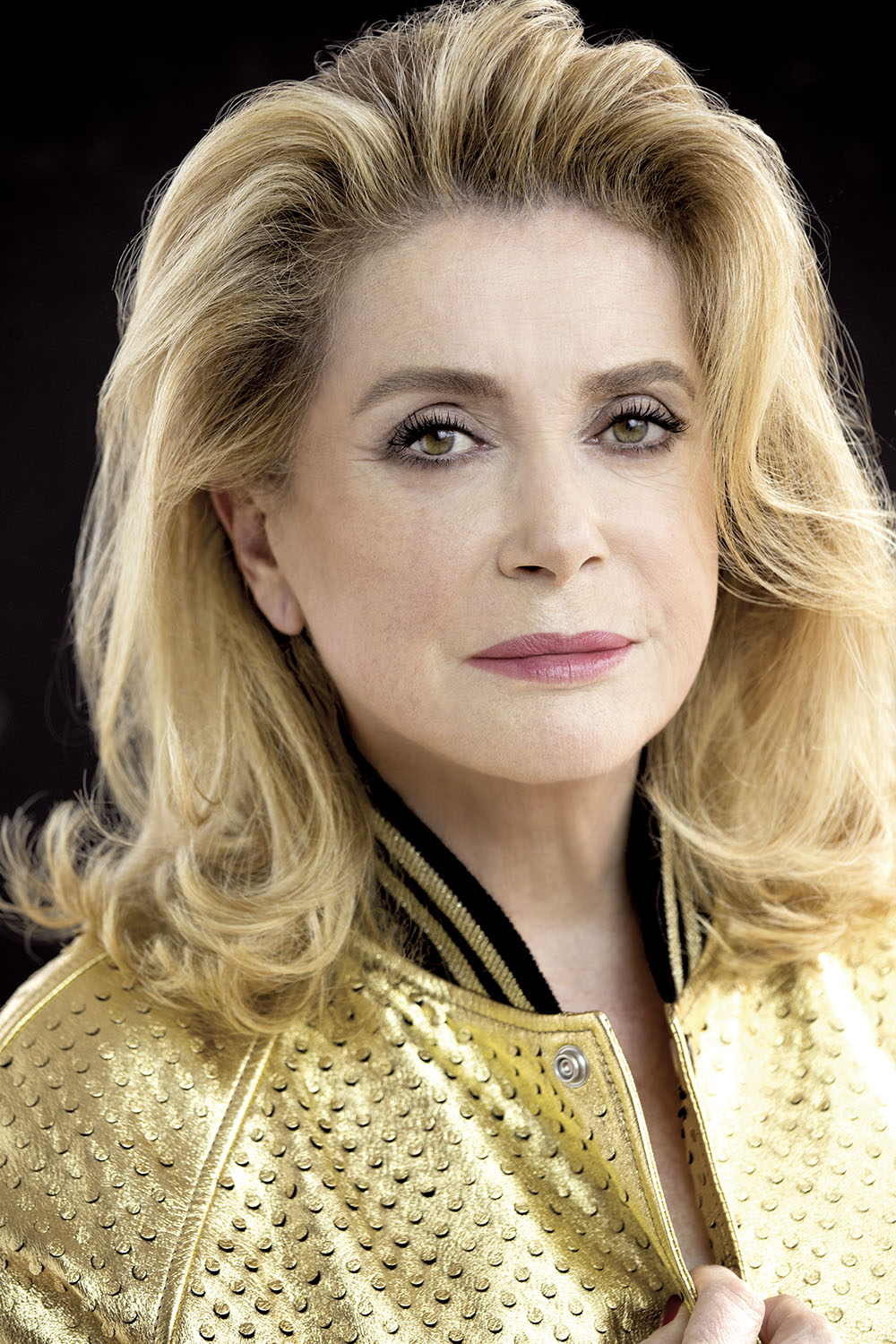
Photos Sylvie Castioni
Stylisme Barbara Loison
Coiffure Jean-Claude Gallon
Maquillage Thibault Vabre
Interview paru dans le Technikart N°217 de novembre 2017